AI session control
See active Codex and Claude sessions, answer approval prompts, continue interrupted work, and receive completion alerts away from the keyboard.
A custom touch terminal for AI work, desktop control, home automation, schedules, and the useful signals that should not stay buried on a PC.
4.3 in
capacitive touch
800 x 480
RGB565 display
240 MHz
dual-core ESP32-S3
16 + 8 MB
flash + PSRAM
WHY IT EXISTS
XPOS started as a dedicated control surface and became a small operating system. It keeps long-running AI work visible, makes common PC actions tactile, surfaces calendar and smart-home state, and turns downtime into an expressive ambient display.
The Waveshare panel is the touch surface and renderer. A custom Windows service handles integrations and privileged desktop actions, then sends compact state over an authenticated local WebSocket. That split keeps the firmware focused and the private data on the owner’s computer.
ESP-IDF, C, LVGL, touch, audio, local state, animation, and OTA updates on the ESP32-S3.
Authenticated WebSocket state, resilient reconnects, screenshot capture, and wireless firmware delivery.
FastAPI, automation adapters, AI-session hooks, cached data, and carefully scoped operating-system controls.
THE SYSTEM
Each surface is designed for a 4.3-inch screen: large targets, short paths, cached state, and overlays only when attention is actually required.
See active Codex and Claude sessions, answer approval prompts, continue interrupted work, and receive completion alerts away from the keyboard.
Launch trusted shortcuts, control media and Discord, resume workspaces, and operate the ETS Dashboard timer from a touch-first hierarchy.
One control surface for lighting, climate, laundry status, entertainment, locks, scenes, and other Home Assistant-backed devices.
Month and agenda views, event details, weather, reminders, and an Overseer briefing sourced from real calendars instead of seeded tasks.
Harmon fills idle time with expressive faces and themed animations, then gets out of the way immediately when the screen is touched.
Private integrations and operating-system actions stay on the owner’s Windows agent. The panel receives only the state required to render and respond.
ON THE DEVICE
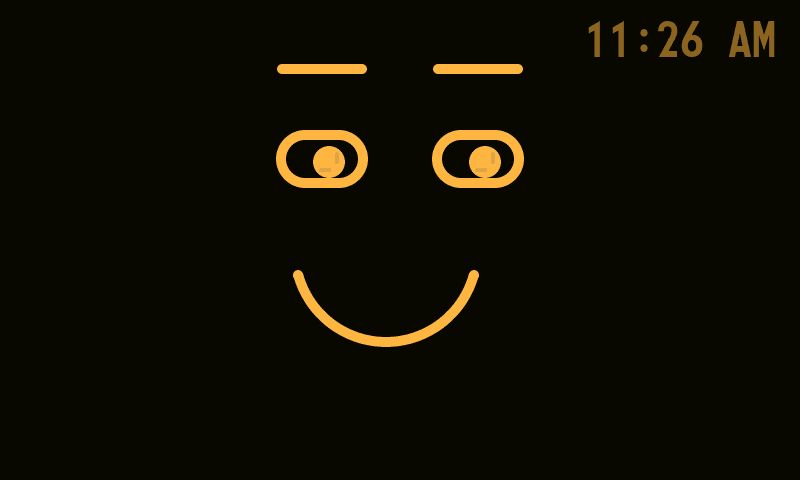
Harmon at rest
After 90 seconds without touch input, XPOS yields to Harmon, an animated idle companion that reacts to status events without interrupting active use.
Captured directly from the physical ESP32-S3 framebuffer on July 17, 2026. No calendar or appointment details, terminal output, account data, network addresses, or personal notifications are shown.
PARTS LIST
The core build is intentionally short. The display board already includes touch, audio hardware, Wi-Fi, Bluetooth LE, RTC, a TF slot, and battery charging circuitry.
4.3-inch 800 x 480 capacitive-touch board. SKU 33799 without a case or SKU 33630 with the plastic enclosure.
A known-good data cable is required for the first firmware flash and serial recovery. Charge-only cables will not expose a COM port.
A regulated USB supply rated for 2A gives comfortable headroom for the display backlight, Wi-Fi, and audio output.
Runs the XPOS Agent, integrations, local automation, and desktop actions. The panel and host must be reachable on the same LAN.
The ESP32-S3 radio supports 2.4 GHz 802.11 b/g/n. A combined-band router is fine when it offers a compatible 2.4 GHz SSID.
ENGINEERING NOTES
CUSTOM HARDWARE + SOFTWARE